Why Your Ethereum Staking Rewards Keep Shrinking (and What You Actually Earn in 2026)
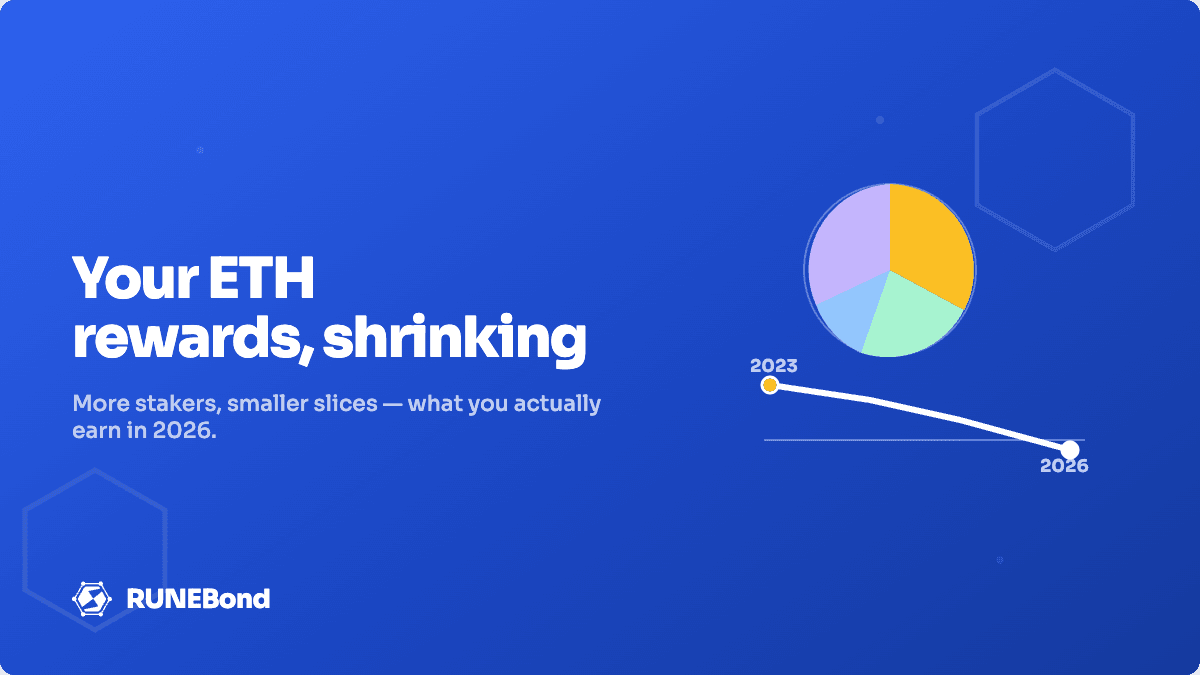
Ethereum staking rewards are shrinking because the reward pool is shared: as more ETH is staked, each staker’s slice gets thinner. In early 2026 the annual reward rate for ETH stakers touched an all-time low near 2.5%. That’s not a bug — it’s how the system prices security. Understanding it helps you compare any staking offer honestly.
The simple math behind shrinking rewards
Think of it as a pie at a dinner table. The network pays a roughly fixed bill every year to keep itself secure, and that bill is split among everyone who shows up to help. Every new staker is one more guest at the same table. Nobody took your slice away — the pie is simply being cut into more pieces. The rate you see quoted is not a promise the network made to you; it’s the result of a division that changes every single day.
Three numbers that show where things stand:
- ETH’s staking rate touched an all-time low of around 2.54% in early 2026, hovering near 2.85% on 10 January 2026.
- Roughly 28% of all ETH was already staked as of January 2026 — more than a quarter of the entire supply competing for the same rewards.
- The validator entry queue swelled to about 1.7 million ETH, translating into roughly a one-month wait just to start earning (January 2026).
Independent guides published in 2026 put the realistic range at 2–3% per year. That’s before your platform’s cut.
Where staking money actually comes from
On any network, staking rewards come from exactly two places, and the difference between them matters more than the headline percentage:
New coins the network prints. The protocol creates fresh tokens and hands them to stakers. This is real money in your wallet, but it comes from diluting every holder who isn’t staking — including, partly, yourself. If a network pays you 8% while inflating supply by 7%, your purchasing power barely moved.
Real fees paid by real users. Someone made a transaction, a swap, a trade, and paid for it. That’s income the network earned rather than printed. It’s harder to grow and far more honest.
Most “high APY” offers in crypto lean heavily on the first source and market it as if it were the second. When you’re comparing platforms, the single most useful question is not how much but funded by what. This is the difference between real yield instead of token inflation and a number designed for a screenshot.
It can also change by decree: the 10% rewards debate
Here’s the part almost nobody mentions when they sell you on staking: the reward rate isn’t a contract. It’s policy, and policy can be voted on.
In June 2026, a proposal known as “Validator Redirected Revenue” — put forward by the founder of Kleros — suggested redirecting up to 10% of Ethereum staking rewards into a public goods funding pool. The debate is live and it may or may not go anywhere. That’s not the point. The point is that a rate you’re counting on can be adjusted by people who are not you, through a process you may not be following. (Source: Investing.com, June 2026)
Every network works this way. The mature response isn’t alarm — it’s factoring governance risk into the comparison instead of pretending it doesn’t exist.
Higher pay exists — because higher responsibility exists
Some networks do pay considerably more than 2–3%. They’re not being generous. They’re asking for more.
Take THORChain, a network that lets people swap assets across different blockchains without an exchange in the middle. The people who secure that network don’t just delegate and forget — they deposit RUNE as a security deposit that can be penalized if their node misbehaves or goes offline. (The technical term is bonding; in plain language, it’s staking with real skin in the game.) In exchange, they earn from two sources: the actual swap fees users pay to move assets, plus network rewards.
As of 22 July 2026, RUNEBond was showing returns of up to roughly 29% annually, varying by node and by market conditions. Treat that number the way you should treat every yield figure, including Ethereum’s: a variable rate on a given date, not a promise. It’s high because the responsibility is real, and because a meaningful part of it comes from swap fees that users genuinely paid — not from an inflation faucet. If you want the mechanics, we covered them in detail in yes, you can stake RUNE.
The honest trade-offs
Higher pay comes with a column of the spreadsheet that promotional pages tend to hide. Here it is:
- Your funds are locked, with exit windows. There is no instant-withdrawal button. Plan around it — we explained the mechanics in lock-ups and exit windows explained.
- You depend on the node operator you pick. Their uptime, their competence and their fee policy directly affect what you earn. Picking blind is the single most common mistake.
- Nodes can be penalized. If an operator runs the node badly, the network fines them — and that’s by design, because it’s what makes the security deposit meaningful. See how node penalties keep the network honest.
If a platform only tells you the big number, be suspicious. Anyone can print a percentage.
Where the yield comes from
| Source of the money | Who holds your keys | Exit window | Range (July 2026) | |
|---|---|---|---|---|
| ETH staking | New issuance + priority fees | You (solo/non-custodial) or the platform | Exit queue, variable | ~2–3% |
| Exchange “earn” products | Platform’s internal economics, often opaque | The exchange | Usually instant, at their discretion | Varies, often below the underlying rate |
| THORChain node staking | Real swap fees + network rewards | You — non-custodial | Defined windows, not instant | Variable, up to ~29% by node |
Rates are variable and dated. Verify before committing capital.
How to compare any staking offer in 5 questions
- Where does the money come from? Real fees, new issuance, or something nobody will explain?
- Who holds my keys? If the answer is “us”, you’re lending, not staking.
- When can I get out? Instant, queued, or after a fixed window?
- What can be cut, and who decides? Fees, reward rates, penalties, governance votes.
- Can I verify the operator before I commit? Track record, terms and fees, visible up front.
If a platform can’t answer all five publicly, that is your answer. On our side, you can compare node operators with public track records before committing a single RUNE, and run your own numbers in the earnings simulator rather than trusting ours. For a structured side-by-side of the two mechanisms — yield source, exit times, slashing — see THORChain vs Ethereum staking.
FAQ
Why did my Ethereum staking rewards go down?
Because rewards are shared across everyone staking. As more ETH gets staked — over a quarter of all ETH by early 2026 — each participant’s share shrinks. Your platform’s fee comes off the top too.
Is staking ETH still worth it in 2026?
It depends what you compare it against. At roughly 2–3% a year (early-2026 range, variable), it’s modest but low-effort. The key is knowing where the yield comes from and what you give up in access to your funds.
Which crypto pays higher staking rewards, and why?
Networks that ask participants to take on more responsibility — locking funds as a security deposit that can be penalized — tend to pay more. Higher pay is compensation for risk and commitment, never free money.
Can staking rewards be changed or cut?
Yes. Reward rates are network policy, not a contract. Ethereum is currently debating a proposal to redirect up to 10% of staking rewards. Any network can adjust its rules through governance.
Do I have to give up my keys to earn staking rewards?
No. Non-custodial options exist on several networks, including THORChain, where you keep your funds in your own wallet and the terms are public before you commit.