THORChain Churn Explained: What Triggers It, and What Changes With v3.20
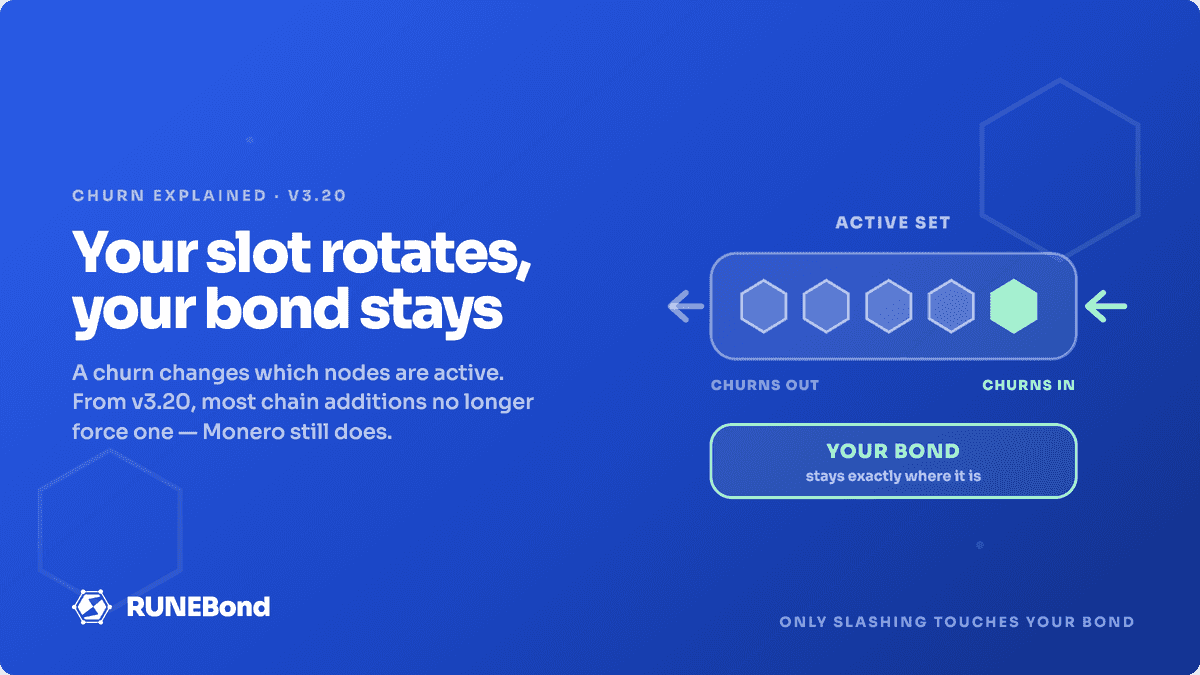
A THORChain churn is the periodic rotation of the network’s active validator set: well-bonded nodes enter, weaker ones rotate out, and the vaults migrate to the new set. Bonded RUNE isn’t spent or moved during a churn itself — but minimum bond thresholds and node performance decide whether a bond provider keeps earning afterward.
That second sentence is the part most people miss, and it’s the reason churn is worth understanding before you commit RUNE to a node rather than after.
What is a churn?
A churn is THORChain’s scheduled reshuffle of who validates. The network doesn’t run on a fixed, permanent committee of nodes. Instead, on a recurring schedule it retires part of the active set, admits standby nodes that are bonded and ready, and migrates the asset vaults from the old set of key-holders to the new one.
This happens roughly every three days. That’s the default rhythm of the network: absent any problem, a churn cycle opens and closes on its own every few days, with no announcement and no trigger event. The cadence is governed by the CHURNINTERVAL mimir value, so like every mimir it can be adjusted by governance rather than being a hard constant.
The important nuance is that this is the happy path. A churn is scheduled, but it isn’t guaranteed to complete on time: if the network is mid-migration, if vaults haven’t finished moving funds to the new set, or if conditions otherwise aren’t safe, the churn is held back until they are. So “every three days” is the cadence to plan around, not a clock you can set a transaction by.
Nothing about that process is discretionary. There’s no committee choosing favourites — the rules live in the protocol and execute on a schedule.
Why THORChain churns nodes
Three reasons, and they compound:
- Security rotation. THORChain’s vaults are secured by threshold signatures, meaning no single node holds a complete key. Rotating the set regularly means an attacker would need to compromise a moving target rather than a fixed group of machines.
- Preventing entrenchment. Without rotation, the same operators would hold the keys indefinitely and accumulate structural power over the network. Churn keeps the door open for new entrants with enough bond.
- Onboarding new capability. Historically, integrating a new chain meant the validator set had to establish a new signing session — which meant a churn.
That third point is exactly what’s changing.
Chain additions and signing algorithms
Not every chain integration is equal from the validator set’s perspective. If a new chain uses a signing scheme the network already supports, the existing key material can cover it. If it needs a genuinely different signing algorithm, the set has to regenerate keys — and that means a full churn.
Until recently, the network treated all chain additions the same way and churned regardless. That’s operationally expensive: every churn is a vault migration, and every vault migration is a window where something can go wrong.
What happens to your bond during a churn
Practically nothing — and this is the single most common misconception.
A churn does not move, spend, or confiscate bonded RUNE. Your bond stays where it is, attributed to the node operator you bonded to. What changes is whether that node is in the active set for the next cycle.
The consequences of that distinction are real, though:
- If your node stays active, nothing changes for you. Rewards keep accruing at the end of each churn cycle.
- If your node churns out, it stops earning network rewards until it gets back in. Your bond is still yours, but it’s idle capital in the meantime.
- Bonded RUNE is only reduced by slashing, which is triggered by specific node faults — never by the churn process itself.
Rewards, it’s worth noting, are distributed at churn boundaries rather than streamed continuously — so in practice, roughly every three days. If you bond mid-cycle, your first payout arrives when the cycle closes, not immediately.
Minimum bond, hard cap, and the bottom-two-thirds rule
Two numbers govern whether a node can be in the set and how much bond is actually productive.
MinimumBondInRune is the network-wide floor to be eligible for the active set. It’s a mimir value — a governance-adjustable parameter — which means it is not a constant. It has moved before and it will move again as network conditions change. Treat any figure you read in an article (including this one) as a snapshot, and read the live value from a THORNode /mimir endpoint before you commit capital.
The hard cap works differently and surprises people more. Effective bond is capped relative to the bond level of the bottom two-thirds of the active node set. Bond beyond that ceiling still counts toward securing the node’s position, but it stops earning proportionally. Because the composition of the active set changes at every churn, the cap itself moves — a node comfortably under the cap this cycle can be over it next cycle without its operator doing anything at all.
For a bond provider, that’s the practical takeaway: a node’s bond level is not a “set and forget” number. It’s a moving position relative to a moving benchmark.
Churn risk for bond providers
Strip away the mechanics and the risks a bond provider actually carries are these:
- Churn-out risk. Your node loses its slot and your capital sits idle until it re-enters. Not a loss of principal, but a real opportunity cost.
- Cap risk. The node accumulates bond past the effective cap, and your marginal contribution stops earning proportionally.
- Commission timing. Operator commission is applied to rewards, and rewards land at churn boundaries. A commission change between cycles affects the payout you were projecting.
- Slashing exposure. You don’t operate the node, but you’re exposed to its faults. A double-sign costs 5% of the minimum bond; an unauthorized transaction costs 1.5x the value moved. These are different orders of magnitude, and both are entirely a function of how well the operator runs their infrastructure.
That last one deserves emphasis: as a passive bond provider, your main lever isn’t market timing. It’s operator selection.
What changes with v3.20
THORChain v3.20 entered testing on 30 July 2026, and it changes when the network is required to churn.
Under the new behaviour, ordinary chain additions no longer force a network-wide churn. If an integration can run on the signing scheme the validator set already uses, the network can add it without rotating everyone.
Monero is the exception. Its signing algorithm is different enough that adding it still requires a full churn — which is precisely why its rollout was framed as a soft launch. (Source: Monero Gets a Soft Launch as THORChain’s v3.20 Enters Testing and ADR31 Passes.)
For bond providers, fewer forced churns cut both ways. Fewer reshuffle events means more stability and fewer vault-migration windows — good if your node is well-positioned. But churns are also the mechanism by which the set opens up, so fewer of them means fewer natural entry points if you’re bonded to a node fighting for a slot near the threshold.
How to track churns and node performance
Most of this information exists on-chain, but it’s scattered across endpoints, explorers, and Discord threads. The things actually worth watching per node are:
- Current bond versus the effective cap — is this node’s bond still productive at the margin?
- Operator commission, and whether it’s changed between cycles.
- Churn history — has this node held its slot consistently, or does it bounce in and out?
- Slash points, the earliest warning that an operator’s infrastructure is degrading.
RUNEBond tracks bond level, commission, and churn history per node in one place, so you can compare operators before bonding rather than reconstructing their track record after the fact.
The short version
Churn is not something that happens to your bond — it’s the rhythm the whole network runs on, and your returns are a function of whether your node keeps its place in it. v3.20 makes that rhythm slower and more predictable by decoupling most chain integrations from the churn requirement, with Monero as the standing exception.
Before your next cycle, check where your node sits relative to the bond cap and what its churn history looks like. Compare active nodes, bond levels, and commission on RUNEBond, or project what a churn-out would do to your returns in the earnings simulator.
Related reading: Slashing in THORChain: the fine that keeps the network honest and RUNEBond risks, lock-ups, and why easy bonding matters.
Frequently asked questions
How often does THORChain churn?
Roughly every three days. A churn runs on a recurring schedule governed by the CHURNINTERVAL mimir value — it does not need a trigger event, and on the happy path it simply happens every few days. It can be delayed if vault migration is still in progress or network conditions are not safe, so treat it as a cadence rather than a precise clock.
Do I lose my bond during a THORChain churn?
No. A churn changes which nodes are in the active set; it doesn't move or confiscate bonded funds by itself. Bonded RUNE is only reduced by slashing, which is triggered by specific node faults, not by the churn process.
What is the minimum bond to run a THORChain node?
The floor is set by the network-wide MinimumBondInRune mimir value. It is a governance-adjustable parameter, not a fixed number — it changes with network conditions, so always read the live value from a THORNode /mimir endpoint before committing capital.
What is the THORChain bond hard cap?
The effective bond cap is tied to the bond level of the bottom two-thirds of active nodes. Bond above that ceiling still secures your position in the set, but it stops earning proportionally — and because the node set changes at every churn, the cap moves with it.
What changed with THORChain v3.20 for churns?
Ordinary chain additions no longer force a network-wide churn. Monero is the exception: its signing algorithm differs enough that adding it still requires a full churn. Source: blog.thorchain.org, "Monero Gets a Soft Launch as THORChain's v3.20 Enters Testing and ADR31 Passes", 30 July 2026.
What is the risk of slashing while bonded?
A double-sign fault costs 5% of the minimum bond, and an unauthorized transaction costs 1.5x the value moved. Both are node-operator-level faults that a passive bond provider does not directly control — which is why choosing a well-run operator matters more than any other single decision.