Solana's SIMD-0550 could cut staking rewards from 5.8% to near 2%: what it means for you
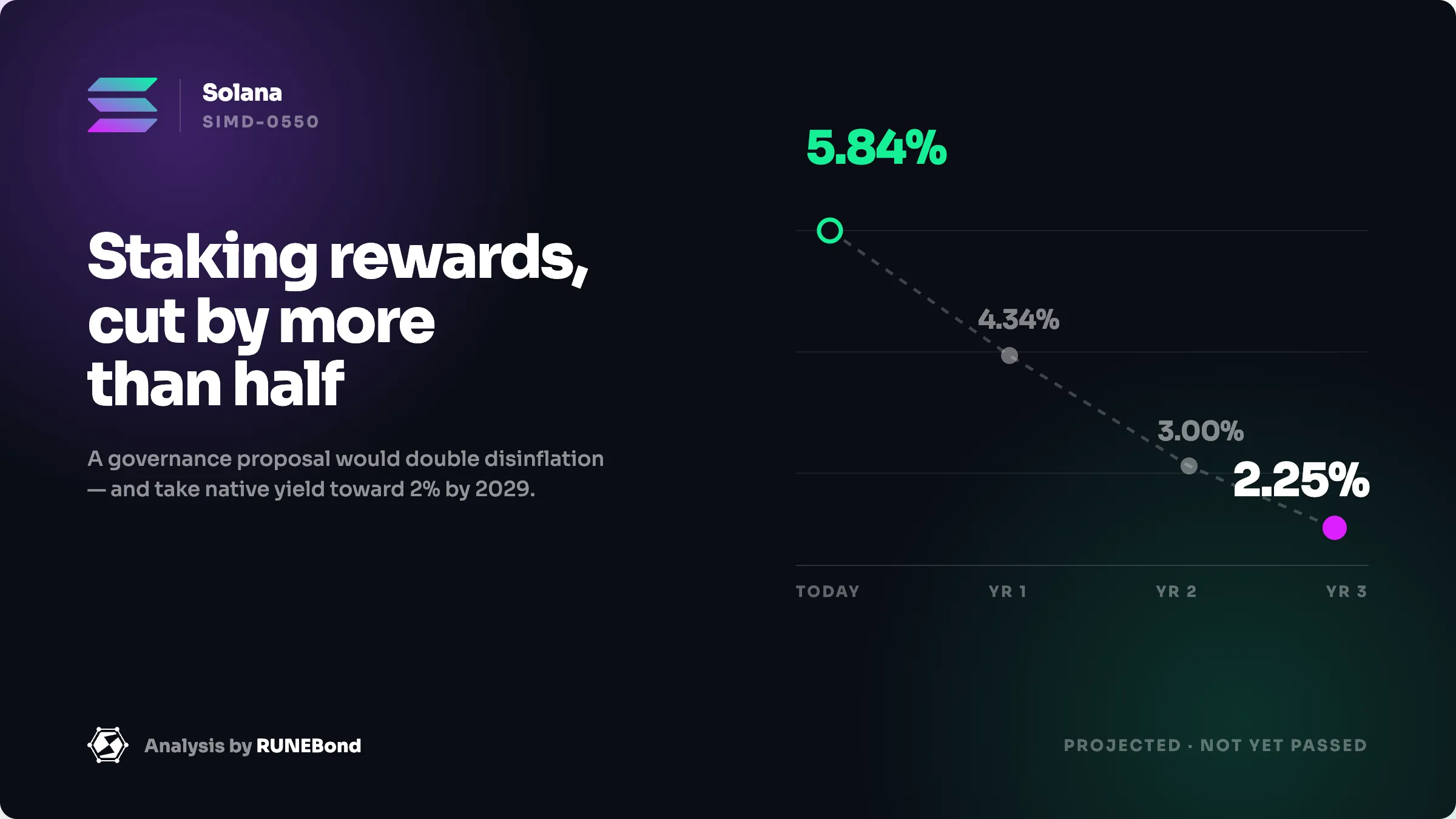
Solana’s SIMD-0550 is a governance proposal that would double the network’s annual disinflation rate from 15% to 30%, shrinking new SOL issuance faster than today’s schedule. It has not passed. It’s still in a validator signaling phase. If it does pass, projected native staking yield would fall faster than it’s already falling.
What SIMD-0550 actually changes
Solana pays staking rewards mostly from inflation: new SOL the protocol creates and distributes to validators and the people who delegate to them. That issuance rate isn’t fixed forever: it’s designed to shrink every year (a “disinflation” schedule) until it hits a permanent floor.
Right now that schedule cuts issuance by 15% a year, heading toward a 1.5% terminal rate. SIMD-0550 proposes doubling that pace to 30% a year. The floor itself doesn’t move (it stays at 1.5%), but the network gets there much sooner: roughly 2029 under the proposed schedule versus roughly 2032 on the current one, according to the modeling published on Solana’s developer forum.
Technically, this would ship as a Solana network upgrade that doubles how fast the disinflation schedule advances, a setting change at the protocol level, not something any single company or exchange controls. The proposal itself, authored by Lostin and 0xIchigo of Helius, was opened on 2 June 2026 and merged into the Solana Improvement Documents repository on GitHub on 23 July 2026. That merge is worth reading correctly: it means the document was formally accepted as a proposal for the community to evaluate. It is not the same as the change being activated on-chain, and as of the most recent reporting it hasn’t been.
How this hits your staking yield
If you stake SOL, either running your own validator or delegating to one, this is the number that matters to you directly. According to the economic modeling published alongside SIMD-0550 on Solana’s developer forum, assuming roughly 68% of circulating SOL stays staked, projected native staking yield would move like this:
| Point in time | Projected native staking yield |
|---|---|
| Today (current schedule) | ~5.84% |
| Year 1 under SIMD-0550 | ~4.34% |
| Year 2 under SIMD-0550 | ~3.00% |
| Year 3 under SIMD-0550 | ~2.25% |
That’s a projected drop of more than half in three years. Two caveats worth sitting with: this is a model built into the proposal itself, not a locked-in outcome, and the actual rate you’d earn also depends on how many other people stake alongside you, the same “shared pie” dynamic that has already pushed Ethereum staking rewards down to roughly 2–3% as participation grew. More stakers competing for a shrinking issuance pool compresses everyone’s share.
If you hold SOL through a liquid staking token instead of staking natively, this still reaches you. Liquid staking providers earn the same underlying native staking yield described above, then pass most of it through to token holders after their own fee. There’s no separate mechanism that shields a liquid-staked position from a lower network-wide reward rate; the issuance pool itself is what shrinks. A slower disinflation schedule means a slower decline for everyone downstream of it; a faster one, like SIMD-0550 proposes, means the decline reaches liquid stakers faster too.
Who actually decides, and when
Two separate approvals stand between SIMD-0550 and reality, and it’s worth being precise about which one is happening right now. The 15%-of-staked-SOL signal described above is a temperature check: it tells validators and the wider community whether there’s enough support to justify moving the proposal to a formal governance vote. Missing that threshold by the 18 August 2026 deadline doesn’t kill the idea forever, but it does mean the current push stalls. Clearing it opens the door to the vote that would actually decide whether the faster schedule ships. Neither step has happened yet.
Why Solana is doing this to itself
The case for SIMD-0550 isn’t about pleasing stakers, it’s about the network’s long-term token economics. The same forum thread estimates the accelerated schedule would avoid issuing roughly 18.9 million SOL over six years, cited in the discussion as approximately $1.51 billion, compared to staying on the current path. Slower, more front-loaded dilution is the argument in its favor.
The counter-argument is just as concrete, and it’s not settled: the same modeling in that discussion projects that around 30 validators would become unprofitable by year three under the faster schedule. Smaller validators typically run on thinner margins than the large operators who can absorb a lower reward rate, so critics point to a centralization risk baked into the proposal: fewer, bigger validators securing the network. This is an active point of disagreement in the debate, not a conclusion either side has won.
Where this stands right now
As of 4 August 2026, CoinDesk covered the state of the signaling vote: SIMD-0550 needs 15% of all staked SOL to signal support before it can move to a formal governance vote. At the time of that report, support stood at 24.94 million SOL, about 5.8% of the 432.65 million SOL then staked.
Support then moved fast. Just a day later, on 5 August 2026, Solana Compass reported signaled support had jumped to roughly 63 million SOL, about 14.4% of staked SOL, leaving a gap of only about 2-3 million SOL short of the 65.16 million SOL (15%) threshold. CoinMarketCap Academy independently corroborated the same order of magnitude that week, also confirming the 15% threshold had not yet been crossed as of its reporting. One nuance worth not skipping past: per Solana Compass, a single validator accounted for roughly two-thirds of that signaled stake, a reminder that “support” here is concentrated, not yet a broad cross-section of the validator set.
As of the most recent confirmed reporting (5 August 2026), the threshold was still short of being met, though the gap had narrowed sharply in a single day. The signaling deadline is 18 August 2026.
In plain terms: this could still fail to reach the threshold and simply not advance. Nothing here is locked in. (The same CoinDesk report also covers a separate, sibling proposal, SIMD-0553, about burning transaction fees from network resource use: a different mechanism worth knowing exists, but not one we have verified figures for here.)
The pattern behind it: inflationary yield is a policy decision, not a promise
Zoom out, and SIMD-0550 is one instance of a pattern that shows up on every network where staking rewards come from token issuance: the rate is not a fixed feature of the asset, it’s a governance parameter, and it can be changed. Ethereum has gone through its own version of this debate as staking participation grew and rewards compressed. Solana’s disinflation schedule is simply Solana’s version of the same lever. The current rate, epoch mechanics and unstaking times are tracked on our Solana staking profile.
That doesn’t make inflationary staking bad. It makes it something you should price with eyes open: the yield you’re counting on today can be voted down by people who aren’t you, through a process you may not be watching. This is the core distinction behind what’s often called real yield versus inflationary yield: rewards funded by newly printed tokens carry governance risk baked in, because the printing rate is a decision. Rewards funded by revenue the protocol actually earns, transaction and swap fees paid by real users, don’t have that same single point of failure. They can still move with usage, but there’s no equivalent of “someone votes to cut issuance in half.”
THORChain, the cross-chain network behind RUNEBond, is one example of the second model. THORChain lets people swap assets across different blockchains without a centralized exchange in the middle, and it’s secured by node operators who lock up RUNE (its native asset) as a bonded security deposit, a mechanism closer to staking with real collateral at stake, called “bonding.” Those operators, and the bond providers who delegate RUNE to them, earn largely from the actual swap fees the network processes, not from an inflation schedule someone can vote to accelerate. If you want the full mechanism, including the trade-offs (lock-ups tied to when an operator’s node next opens a window, and the risk of penalties if a node misbehaves), that’s covered in RUNE staking without running a node.
None of this is a claim that any specific yield figure is fixed or guaranteed, RUNEBond’s own rates are variable and shown live in the app, not promised here. If your Solana staking yield sliding toward 2% by 2029 has you thinking about where else your crypto could be working, that’s a reasonable moment to compare current node operators and see live yield on RUNEBond before deciding anything.
Frequently asked questions
What is SIMD-0550?
SIMD-0550 is a Solana Improvement Document that proposes doubling Solana's annual disinflation rate from 15% to 30%, which would shrink new SOL issuance and staking rewards faster than the network's current schedule. It's a governance proposal, not a decided outcome.
How would SIMD-0550 change Solana staking rewards?
Under the model published with the proposal, projected native staking yield (assuming roughly 68% of SOL staked) would fall from about 5.84% today to roughly 4.34% in year one, 3.00% in year two, and 2.25% in year three. These are model projections, not guaranteed rates.
Has SIMD-0550 passed yet?
No. The proposal document was merged into the Solana Improvement Documents repository on 23 July 2026, which only means it was formally accepted for discussion. As of 4 August 2026 it was still in a validator signaling phase that needs 15% of staked SOL to advance, with a deadline of 18 August 2026.
Why would Solana want to cut its own staking rewards?
The proposal's authors argue current issuance is unsustainable long-term. Their own modeling projects roughly 18.9 million SOL (about $1.51 billion) in emissions avoided over six years by reaching the terminal inflation rate sooner. The trade-off flagged in the same discussion: their modeling shows around 30 validators could become unprofitable by year three, which raises centralization concerns since larger validators absorb thinner margins more easily than small ones.
Is Solana staking still worth it if this passes?
That depends on your own goals and risk tolerance, and it's not something we can tell you. What's worth knowing is that the yield is a policy variable, not a fixed feature of holding SOL. The same is true of most inflation-funded staking rewards on any network.
Can staking rewards on any crypto network just be voted down?
Yes, when the reward comes from token issuance, because issuance is a protocol parameter that governance controls. Ethereum has faced similar proposals to redirect staking rewards. Yield paid from actual protocol revenue, rather than newly printed tokens, does not have the same single point of adjustment.