Can Bonded RUNE Be Used as Collateral on THORChain? What RUJI Money Market Doesn't Cover
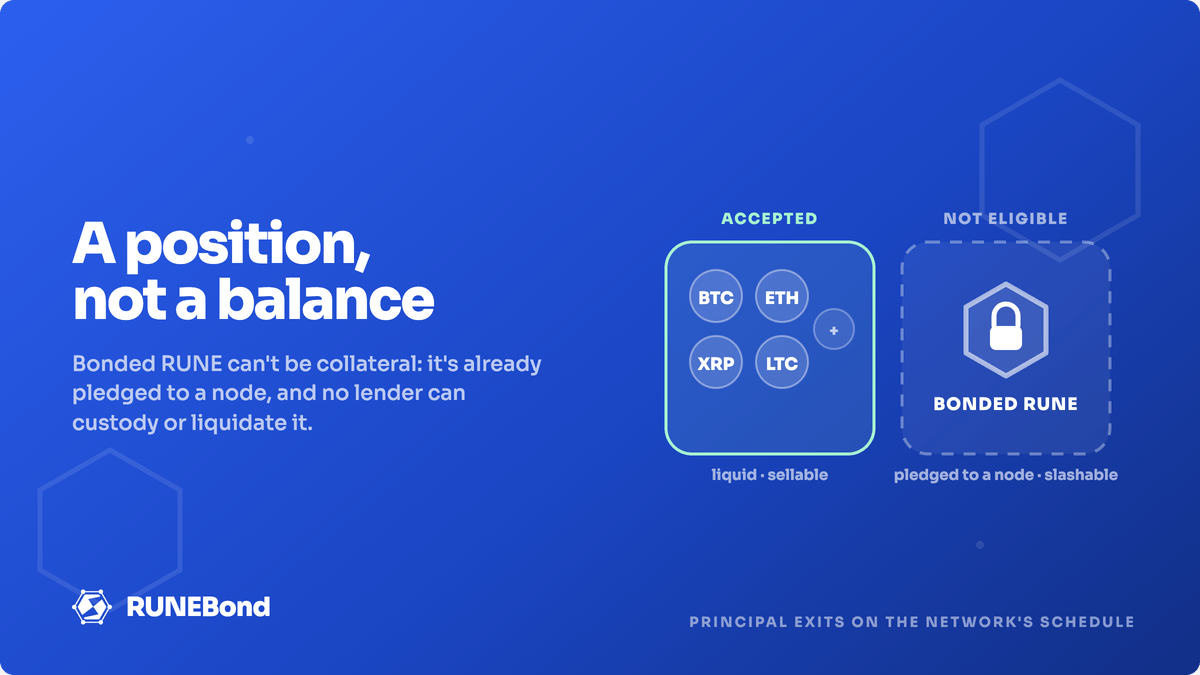
No. As of August 2026, RUJI Money Market accepts native assets connected to THORChain as collateral — BTC, ETH, XRP, BCH, LTC, DOGE and stablecoins among them — and bonded RUNE is not one of them. RUNE locked to a THORChain node stays illiquid until it is unbonded, and unbonding is tied to the network’s churn cycle rather than a fixed timer. The principal can’t be short-circuited — but accrued rewards are a separate matter, and that’s where bond providers actually have options.
That’s the short answer, and it’s the question that started arriving the moment multi-collateral borrowing went live on 30 July 2026. The longer answer is more useful, because the reason bonded RUNE isn’t eligible tells you something about what bonding actually is — and what your real options are if you need capital back before your node lets go of it.
What Rujira’s money market actually is
Some context first, because the naming trips people up. Rujira is the app layer on THORChain — an integrated suite of DeFi products built directly on the protocol, spanning spot and margin trading (RUJI Trade), automated market making (RUJI AMM), and lending. RUJI Money Market is the lending piece of that suite, and multi-collateral borrowing went live on it on 30 July 2026.
The model is conventional overcollateralised lending. You deposit an asset, the protocol assigns it a collateral value with a haircut, and you borrow against that value up to a limit. If the market moves against you and your collateral ratio breaches the liquidation threshold, the position is liquidated to make lenders whole. Interest splits 90% to lenders and 10% to protocol revenue.
The collateral side is deliberately broad — native assets connected to THORChain, plus LP tokens — and it’s expanding, so treat any enumerated list (including the one above) as a snapshot rather than a fixed set. But breadth isn’t the issue for bond providers, because the constraint isn’t which assets have been added yet. For overcollateralised lending to work at all, the protocol needs two things from anything it accepts: it must be able to hold the collateral, and it must be able to sell it quickly if the position goes bad. Bonded RUNE fails both — and no amount of list expansion fixes that.
Why bonded RUNE isn’t borrowable collateral (and won’t be)
This is the part worth internalising, because it’s not a gap waiting to be filled in a future release.
When you bond RUNE to a THORNode, you are not depositing a token into a vault that holds it on your behalf. You are committing capital to a specific node as security for that node’s honest behaviour. That capital is the thing at risk if the node double-signs or signs an unauthorized transaction. It’s the network’s collateral already — pledged to THORChain’s security model, in a state where it can be reduced by slashing at any moment.
A lending market cannot take a second lien on collateral that is already pledged, can be unilaterally reduced by a third party’s misbehaviour, and cannot be seized and sold on liquidation. There is no mechanism by which the Money Market could foreclose on your bond.
So bonded RUNE isn’t excluded because nobody got round to it. It’s excluded because it isn’t a liquid asset at all — it’s a position.
Bonded RUNE vs. bRUNE
The distinction that confuses people is between bonded RUNE and bRUNE — the liquid staking token for RUNE, and the only tokenised version of a RUNE bond position that exists. It recently launched on mainnet.
- Bonded RUNE is capital committed directly to a node under a specific operator’s terms. You earn node rewards net of that operator’s commission, you take that operator’s slashing risk, and your exit is the unbond process.
- bRUNE is a token. It can be transferred, traded and — in principle — used as collateral somewhere, because it’s a balance rather than a position. It also removes the whitelist step: no contacting an operator to be approved before you can put RUNE to work.
That convenience isn’t free, and the clearest cost is a fee layer that direct bonding doesn’t have. The bRUNE contract charges its own 10% fee on bonding rewards — and that sits on top of the commission the underlying node operators charge, which they collect from bRUNE independently. So your yield passes through two cuts before it reaches you, not one. Bond directly and there’s only the operator’s commission, on terms you agreed to up front.
The rest of the trade-off follows from the same structure. A liquid staking token puts an issuer and a contract between you and the underlying bond, adding redemption risk and smart-contract risk that direct bonding doesn’t carry. And because the contract spreads capital across a diversified set of nodes, you get a blended yield rather than a specific operator’s terms you chose. Direct bonding trades liquidity and convenience for control over exactly which node holds your capital, at what commission, and for keeping the full reward net of that single fee.
There’s also a ceiling on how much of the network bRUNE can represent. Its supply is capped at a percentage of THORChain’s total bond, deliberately — if a single liquid wrapper came to sit on top of too large a share of the capital securing the network, that concentration would itself become a systemic risk. Sensible design, but it has a practical consequence: bRUNE can’t absorb unlimited demand. Once the cap is reached, direct bonding isn’t the slower alternative to it, it’s the only route left.
Neither is strictly better, but they’re not interchangeable — and the property that separates them is precisely the liquidity a lending market requires. Worth knowing which trade you made before you go looking for the other one’s benefits.
How long does unbonding actually take?
There is no published countdown, and anyone quoting you a fixed number is simplifying.
Your RUNE can’t leave while the node it’s backing is actively validating. That’s the whole rule, and everything else follows from it.
THORChain rotates its nodes on a schedule — roughly every three days. Each rotation can remove up to three nodes, chosen on three different criteria: the oldest node in the set, the worst-performing one, and the one with the smallest bond. Your capital is freed when your node is one of the ones on the way out. Until then it stays where it is, no matter when you decided you wanted out.
So the question isn’t “how long does unbonding take”. It’s “when does my node become one of the three that leaves” — and that depends on how it ranks against the rest of the set on age, on performance, and on bond size.
Three things follow from that:
- Timing isn’t yours to choose. Deciding to exit right after your node rotated out is a very different wait from deciding right after it rotated in.
- A well-run node is a node that keeps your capital. Two of the three exit routes are effectively penalties — poor performance and a thin bond. A healthy, competitive node avoids both, which is exactly what you want from it and exactly what stands between you and an exit.
- The schedule can slip. Rotations get held back when the network isn’t in a safe state to move funds around. Three days is the rhythm, not a guarantee.
And three exits per churn doesn’t clear a full active set quickly. Against the number of nodes in it, most are waiting a long time for their turn — in practice, the wait to get your bond back has ranged from around a month to as much as a year, depending on the node you picked.
That’s the number that should shape the decision. Bonding isn’t a fixed lock-up you can put in your calendar, like the 21 days you might know from other networks. It’s open-ended, and open-ended is harder to plan around than long.
You can narrow it down, though. Age is the most predictable of the three exit routes, so counting the nodes that have been active longer than yours gives you a workable upper bound. RUNEBond calculates exactly that for every node and shows it as maximum time to leave, in plain days and hours.
It’s a ceiling rather than a forecast — deliberately so. It assumes the slowest case of one exit per churn, so the real wait is often shorter, and a node that slips on performance or falls to the smallest bond can leave well before its age says it should. Operators leaving voluntarily and forced removals shift it too. But it’s the difference between choosing a node knowing it might hold your capital for a year and finding that out afterwards — which is why it’s worth checking before you bond.
What your real liquidity options are as a bond provider
Here the distinction that matters is between your principal and your rewards. They have completely different liquidity profiles, and conflating them is the source of most of the confusion.
Your principal exits on the network’s schedule, not yours. There is no mechanism — on RUNEBond or anywhere else — that hands back bonded RUNE ahead of the rotation. You request the unbond, your node’s turn comes, you get the RUNE back. Nothing is deducted from the principal itself for leaving.
Put plainly: your bond only comes back when the node leaves the network. There’s no date attached to that, and nothing you do as a bond provider brings it forward. Depending on where the node sits in the queue, the wait can run anywhere from about a month to a year.
There is one way it happens faster, and it isn’t yours to trigger: the operator can voluntarily request that their node leave at the next churn. That collapses a months-long wait into days. Which means your exit doesn’t only depend on the queue — it depends on whether your operator is willing to act. One more reason to know their stance on unbonding before you commit capital, not after.
Your rewards don’t have to wait for the same event. By default, bond rewards build up against your position and only become yours to move when the node rotates out — so your yield inherits the same open-ended wait as your principal. RUNEBond’s reward claiming breaks that link, letting bond providers take their rewards without waiting for the node to rotate out.
A few things to understand about it before you count on it. It applies to recent rewards rather than everything you’ve ever accrued, and it carries a fee — the price of not waiting. It runs on liquidity RUNEBond sets aside for it, so availability depends on how much is allocated at the time. It doesn’t touch THORChain’s protocol logic, validator keys, or anything security-critical. The eligibility window and the fee are set in the feature’s documentation, and they change with conditions — read them there rather than trusting a figure quoted anywhere else.
It’s a real improvement on the default, but a narrow one. If there’s a realistic chance you’ll need capital on a timeline you control, the honest planning assumption is still that your principal stays committed until your node’s turn comes. (More on how reward liquidity works.)
The risk side: what can go wrong while you’re bonded
Illiquidity is the constraint people ask about. It isn’t the largest risk they carry.
The bond can be taken from you. That’s the whole point of it — it’s forfeitable so the network has something to seize if the node it secures misbehaves. Routine consensus faults are penalised at one scale; a node that signs a transaction it had no business signing is penalised at a far heavier one, tied to the size of what it moved. As a passive bond provider you control neither outcome. You’re inheriting the quality of someone else’s infrastructure and operational discipline. (The full breakdown of how slashing works and what it costs.)
Operator counterparty risk. Commission terms, unbond policy and how responsive the operator is when something needs doing are all things you’re relying on and none of them are enforced by the protocol on your behalf. Read the operator’s stated terms before requesting whitelist, not after your bond is committed.
Idle capital, and bonding into a node that’s already full. A node that rotates out stops earning until it’s back in — your RUNE is safe, just not working. And every node has a ceiling above which extra bond stops earning its full share; that ceiling moves as the network changes, so a node that’s comfortably under it today can be over it next week without its operator doing anything. Neither is something you control after the fact, which is why both are worth checking before you commit.
Notice what all three have in common: none of them are things you can fix once you’re in. You can’t renegotiate commission mid-bond, you can’t improve someone else’s server hygiene, and you can’t move capital out of a node that’s still validating. Every one of these decisions is made at the moment you choose which node to bond to — which is why that choice deserves more scrutiny than the question of when to bond.
The short version
Bonded RUNE isn’t eligible collateral, and it shouldn’t be. A bond isn’t a balance sitting in your wallet — it’s capital already pledged as security for a node, it can be taken if that node fails, and it only comes back when the node leaves the network.
That’s a perfectly good trade if you made it deliberately. It’s an unpleasant discovery if you didn’t. So make the liquidity question part of the decision up front: look at how long a node is likely to hold your capital via its maximum time to leave before you commit to it, not on the day you want out. Node listings with that estimate, current bond and commission are here.
If you’re weighing this against bRUNE, the comparison worth running is a full cycle: our earnings simulator shows what a direct bond returns after operator commission, which is the figure to set against a liquid token’s stacked fees.
More on the mechanics behind this: how node rotation works and what it means for your bond, and what a slash actually costs.
Frequently asked questions
Can I use bonded RUNE as collateral on RUJI Money Market?
No. RUJI Money Market — the lending product in Rujira's DeFi suite on THORChain — accepts native assets connected to THORChain as collateral, such as BTC, ETH, XRP, BCH, LTC and DOGE. Bonded RUNE is not eligible, and the reason is structural rather than a pending feature: bonded RUNE is not a token balance you hold, it is capital locked to a specific THORNode as security for that node's behaviour, which a lending market can neither custody nor liquidate.
How long does it take to unbond RUNE from a THORChain node?
There is no fixed countdown. Your RUNE is only released when the node it is backing leaves the network. THORChain rotates roughly every three days and can remove up to three nodes each time — the oldest, the worst-performing, and the one with the smallest bond — so the wait depends on how your node ranks against the rest of the set, not on when you decided to leave. In practice that has meant anywhere from about a month to a year. An operator can also request that their node leave at the next churn, which shortens it considerably. RUNEBond shows an estimate per node called maximum time to leave, which is the practical way to plan for it before you bond.
Is bRUNE the same as bonded RUNE?
No. Bonded RUNE is capital committed directly to a THORNode under that operator's terms, and it earns node rewards net of that operator's commission. bRUNE is the liquid staking token for RUNE — the only tokenised version of a bond position — and it is a separate instrument with its own issuer, redemption mechanics and smart-contract risk. It is transferable and skips the whitelist step, but it charges a 10% fee on bonding rewards on top of the commission the underlying node operators already collect, and it gives you a blended yield across a diversified set of nodes rather than a specific operator you chose. Its supply is also capped at a percentage of THORChain's total bond, so it cannot absorb unlimited demand — beyond that ceiling, direct bonding is the only route. Liquidity is exactly the property that distinguishes them, and it is not free.
What happens to my rewards while I am waiting to unbond?
They keep accruing. Rotating out of the active set is what releases your capital, not what stops your earnings up to that point — rewards already earned stay credited to your position. What does cost you is the gap afterwards: once the node is out, that capital sits idle until it is back in or you have moved it elsewhere. That idle stretch, rather than any loss of principal, is the real price of a badly timed exit.
Is bonded RUNE at risk while it is locked?
Yes, in one specific way. The bond exists to be forfeitable if the node it secures misbehaves, so a node that signs something it should not can see part of that bond taken. The amounts scale with the severity of the fault, and an unauthorized transaction is far more costly than a routine consensus fault. None of it is under a passive bond provider's control, which is why the operator you pick matters more than the timing of when you bond.
How can I get liquidity before a full unbond completes?
Your principal cannot be released ahead of the rotation — no mechanism short-circuits that. Your accrued rewards are different: RUNEBond's reward claiming lets bond providers take their rewards without waiting for the node to rotate out. It applies to recent rewards rather than everything accrued, and it carries a fee. It runs on liquidity RUNEBond allocates to it, so availability can vary. Check the feature documentation for the current eligibility window and fee.