THORChain bond providers explained: how staking RUNE through a pooled THORNode works
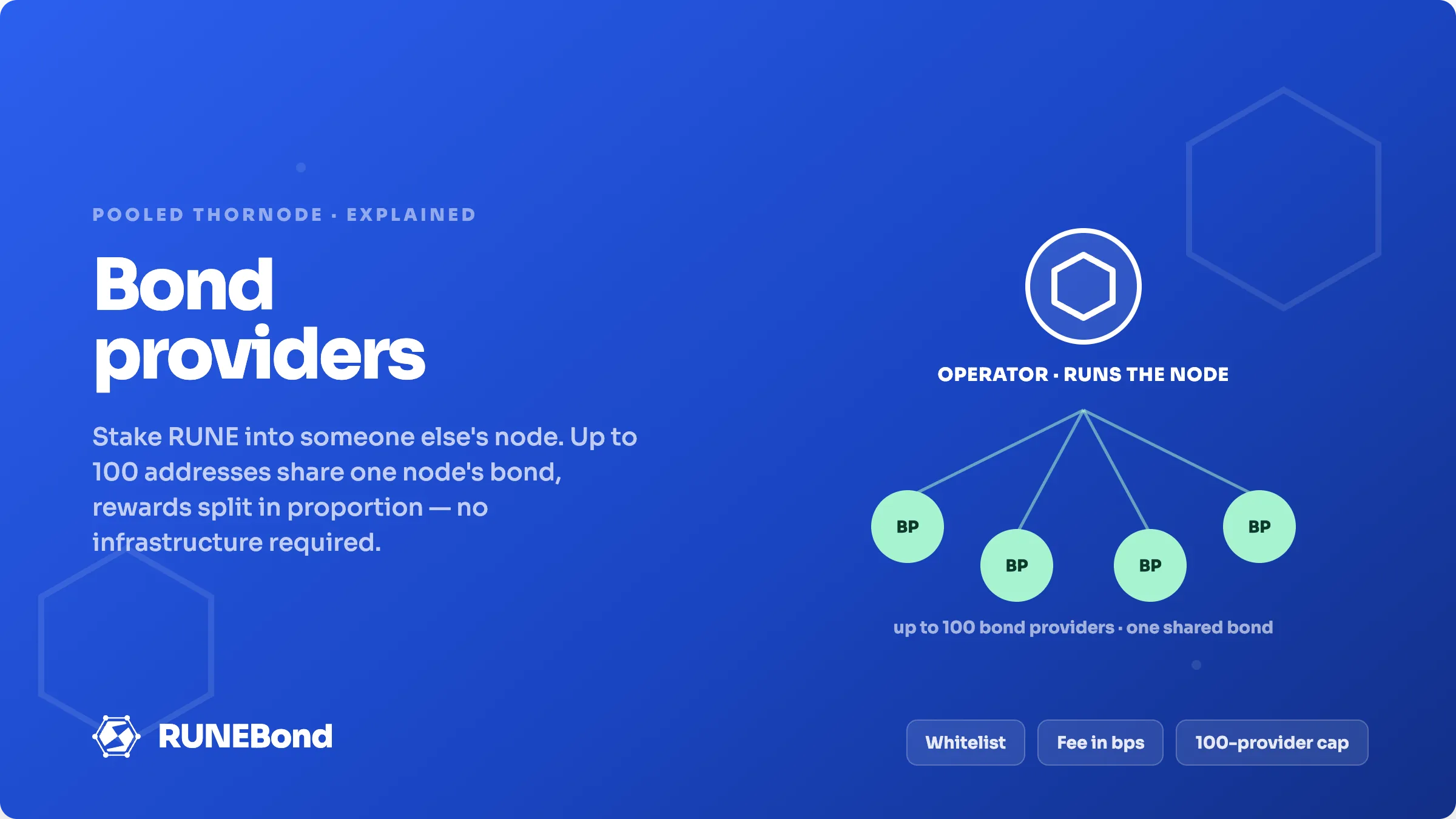
A THORChain Bond Provider is a RUNE holder who bonds to a node operator’s Pooled THORNode instead of running a validator alone — THORChain’s equivalent of staking or delegating on other proof-of-stake networks. The operator whitelists provider addresses — up to 100 per node — and sets a commission in basis points taken from rewards.
This is native protocol functionality, not a third-party product, and it has existed for years. We’ve already argued the case that RUNE staking is possible without running a node. This piece is the mechanism itself: what the operator controls, what the protocol controls, what it costs you, and the exact sequence to go from “I hold RUNE” to “I’m staked into a node”.
THORChain and RUNE in two minutes
If you arrived here from another chain, this is the context the rest of the article assumes.
THORChain is a cross-chain liquidity protocol. It lets people swap native assets between blockchains, for example BTC for ETH, without wrapped tokens, bridges or a centralized exchange in the middle. The assets sit in vaults controlled by the network itself.
RUNE is THORChain’s native token and it sits at the center of that design. Every liquidity pool pairs an external asset with RUNE (BTC/RUNE, ETH/RUNE), and RUNE is the settlement asset between chains.
The network is run by node operators. Their nodes observe inbound transactions on the connected chains, sign outbound ones, manage the vaults and reach consensus with each other. To take part, a node has to lock RUNE as collateral: its bond. Honest nodes earn rewards, paid largely from swap fees generated by real usage; faulty or malicious ones can be slashed. The more value the protocol holds, the more bond it needs to stay secure.
Running a node takes infrastructure, operational discipline and a large amount of RUNE. Being a bond provider is how everyone else takes part in that same security model and its rewards.
First, the vocabulary: bonding is staking RUNE
This confuses a lot of people before they even reach the mechanics, so let’s clear it up first.
If you’re looking for how to stake RUNE, bonding to a node as a bond provider is the answer. They’re not two products. They’re one mechanism with two vocabularies: “bonding” is the protocol’s own term, and “staking” is the word the rest of the industry uses for the same shape of thing.
Here’s the mapping, term for term:
| What you’d call it elsewhere | What THORChain calls it |
|---|---|
| Staking / delegating | Bonding |
| Delegator | Bond provider |
| Validator | THORNode |
| Validator commission | Operator fee (in basis points) |
| Staking pool | Pooled THORNode |
| Unstaking / unbonding period | Unbond, released when the node churns out |
| Liquid staking token | bRUNE |
So “how to stake RUNE”, “delegate RUNE to a node” and “become a THORChain bond provider” are three ways of asking the same question, and everything below answers all three.
The reason the protocol insists on its own word is not pedantry, and it’s the one distinction worth carrying with you: THORChain is a Proof of Bond network. On most proof-of-stake chains, stake is weight behind a validator. Here, the bond is collateral that underwrites the assets in the protocol’s vaults — it exists to be seized if the node it secures misbehaves. Same user experience, harder-working capital, and a genuinely different risk profile from staking a chain where slashing is a rare edge case.
Two practical consequences follow, and they’re where the analogy stops:
- It’s permissioned. There’s no open delegation. The operator has to whitelist your address before your stake counts as bond.
- There’s no fixed unstaking period. Your exit tracks THORChain’s churn cycle, not a 21-day countdown.
With that settled, the mechanism.
What a Pooled THORNode actually is
The bond a node posts is collateral, in the literal sense — and the protocol does not require it to come from one wallet.
That’s the whole basis of the model. Where other chains let many delegators back one validator, THORChain lets many addresses contribute to one node’s collateral.
A Pooled THORNode is a node whose bond is contributed by several addresses. One of them is the operator, who runs the infrastructure and holds the node’s keys. The others are bond providers: addresses the operator has explicitly authorised, which contribute capital and receive a proportional share of the node’s rewards.
Three things follow from that structure, and they’re the whole model:
- Rewards are proportional. Your share of the node’s rewards matches your share of the node’s total bond, net of the operator’s commission.
- Risk is proportional too. A slash reduces the node’s bond, and every contributor’s position with it. You take the same haircut as the operator, in the same proportion.
- The relationship is permissioned. The operator decides who gets in. This is the part that trips everyone up, and it’s covered in detail below.
You are not lending to the operator, and the operator is not custodying your RUNE. Your bond sits on-chain against a specific node address, attributed to your address. What you’re trusting the operator with is the behaviour of the node your collateral secures — not the coins themselves.
The minimum bond figure isn’t your minimum
The number that stops most people is the network’s minimum bond, widely quoted at around 300,000 RUNE.
Two corrections are needed there.
First, it’s not a constant. It’s set by the MinimumBondInRune mimir value — a governance-adjustable parameter that moves with network conditions. Any figure published in an article, this one included, is a snapshot.
Second, and more importantly, it applies to the node, not to you. It’s the floor a node’s total bond must clear to be eligible for the active set. Whether that total comes from one wallet or from twenty is irrelevant to the protocol.
So there are two minimums, and conflating them is the mistake:
| Set by | Applies to | |
|---|---|---|
| Network minimum bond | THORChain governance (MinimumBondInRune) | The node’s total bond, to be eligible for the active set |
| Operator minimum | The node operator, per node | Each individual bond provider |
The second one is the only one you have to clear personally, and it’s an operator’s commercial decision. Some set it low to fill capacity quickly; others set it high to keep their provider list short and manageable. It varies enough between nodes that comparing it is a real part of choosing where to bond.
How the operator fee works
The operator’s commission is set explicitly, on-chain, in basis points — hundredths of a percent, where 10,000 bps is 100%.
10000— the operator keeps everything. Rewards on provider bond go entirely to the operator.5000— a 50/50 split.1000— the operator takes 10%, providers keep 90%.
Two details matter more than the number itself.
It comes out of rewards, not principal. The commission is deducted when rewards are distributed at churn. It doesn’t touch the RUNE you bonded.
It’s a node parameter, not a private agreement. It’s set at the node level and readable by anyone, which is far better than a verbal agreement in a private chat. But it also means the fee belongs to the node, not to your particular deal. An operator can change it, and no protocol rule guarantees the rate you saw on the day you bonded. That’s a reason to prefer operators with a public, stable history over whoever offers the lowest number this week.
Rewards themselves accrue to your bond position rather than landing in your wallet, so they compound into the capital they were earned on. The flip side is that they inherit the same illiquidity as the principal — they become movable when the node leaves the active set. That’s the default, and it’s the constraint RUNEBond’s reward claiming is built to loosen; the trade-offs are covered in the liquidity article.
The cap: 100 bond providers per node
A single THORNode can have up to 100 whitelisted bond providers. It is a design limit, and it is worth knowing that it exists — but it is not what stands between you and a bond today. Most nodes are far from reaching it.
Two other limits matter much more in practice:
- How much bond the operator wants to take. Operators publish the capacity they are accepting, and it is their decision. A node can stop accepting new bond long before it runs out of provider slots.
- How much bond the node can hold and still earn well. Every node reaches a point where additional bond stops earning its full share of rewards. That point moves as the rest of the network changes, so a node that has room today may not have it next month.
So the reputation bonding has for being closed off does not come from the 100-provider cap. It comes from the step before it.
Why whitelisting is the hard part
Before any bond you send is accepted, the operator has to add your specific address to their node. Send RUNE without that step and it doesn’t become a bond.
Historically, arranging it meant finding the operator — Discord, Telegram, X — asking to be added, and hoping for a reply. That process has three problems that have nothing to do with THORChain’s design:
- It isn’t discoverable. There’s no canonical list of which nodes are taking providers, at what fee, with what minimum.
- It isn’t comparable. Terms quoted in private conversations can’t be set side by side.
- It leaves no record. A promise made in a DM isn’t evidence of anything, in either direction. Operators can’t demonstrate a history of dealing fairly, and providers can’t check one.
The protocol solved the hard problem — shared bond with proportional rewards and an explicit fee — and left the coordination problem entirely to the social layer.
RUNEBond’s approach is to move that coordination on-chain. A whitelist request is a 0.1 RUNE transaction carrying a structured memo that names the node, your wallet and the amount you intend to bond; the operator’s response is a transaction too. The memo format is a RUNEBond convention rather than part of the THORChain protocol, but the transactions are ordinary THORChain transactions, publicly readable by anyone — including interfaces other than ours. Both sides accumulate a history that can be checked. The full format and walkthrough are in the docs.
Step by step: becoming a bond provider
1. Find a node with an open slot and terms you accept
Compare on fee (in bps), the operator’s minimum bond, current total bond and remaining capacity, and whether the node is Active or Standby. Node listings are here, and the find nodes doc explains each field on the card.
Run the numbers before you commit rather than after: the earnings simulator shows what a given bond returns net of a given operator commission, which is the figure that actually matters.
2. Get whitelisted
Submit the request to the operator for the specific address you’ll bond from, and be precise — an approval covers that address, not you as a person. If you plan to bond from a different wallet later, that’s a second request.
Two things worth doing before you send it: read the operator’s stated terms in full, and ask them anything you’re unsure about. RUNEBond has on-chain chat for exactly this, and node profiles where operators publish who they are and how they run things. An operator who won’t answer questions before you bond is unlikely to become more communicative afterwards.
3. Bond once you’re approved
After the operator has whitelisted your address, you send your bond transaction from that address. Amount, destination and memo all have to be right — a bond transaction is not a payment that gets refunded on a typo. Follow the current instructions in the app or the docs rather than a format copied from a forum post, since these details do change between protocol versions.
4. Track it, and know your exit before you need it
Once you’re bonded, watch three things: whether the node stays in the active set, whether its performance holds up (slash points are the leading indicator — the slash monitor tracks them), and how your rewards actually land each churn against what you modelled.
And understand the exit before you need it. Bonded RUNE cannot leave a node that’s in the active set, so unbonding isn’t a notice period you serve — it’s a queue you wait in. RUNEBond estimates it per node as maximum time to leave. Check it before you bond, when it’s still an input to the decision.
What to check before you commit
A short list that separates a node worth bonding to from a node with an open slot:
- Fee in basis points, and whether the operator has a record of keeping it stable.
- Operator minimum, against what you intend to bond.
- Remaining capacity — both slots and the point above which extra bond stops earning its full share.
- Node status and performance history. Standby earns nothing; slash points signal operational problems before they become losses.
- Estimated time to leave, because that’s how long your capital may be committed.
- The operator’s stance on unbonding. They can voluntarily take the node out at the next churn, which collapses a months-long wait into days. Whether they will is a matter of policy, not protocol.
The risks, briefly
Being a bond provider carries the same risks as being an operator, minus the ops work and plus a dependency on someone else’s competence:
- Slashing reduces the node’s bond proportionally, providers included. It’s the whole point of a bond being a bond. (What a slash actually costs.)
- Illiquidity is open-ended rather than long. Your exit follows the churn queue. (How rotation works.)
- Operator counterparty risk covers fee changes, uptime, responsiveness and unbond policy — none of it enforced by the protocol on your behalf.
- Idle capital while a node sits in standby: safe, but not earning.
- Price exposure. While bonded you cannot sell, so a fall in the RUNE price during the lock-up can outweigh the rewards earned. (The full risk breakdown.)
None of these are fixable after the fact. You can’t renegotiate a commission mid-bond, improve someone else’s server hygiene, or withdraw from a node that’s still validating. Every one of them is decided at the moment you choose the node — which is why diversifying across several operators is the standard advice, and why it’s good advice.
Bond provider vs. bRUNE
The alternative route is a liquid bonding token. bRUNE is a token that represents bonded RUNE: transferable, no whitelist step, no operator to pick.
The short version of the trade-off is that liquidity costs you choice and a second fee layer — the token’s own cut sits on top of the commission the underlying node operators already take — while direct bonding gives you a specific operator on terms you saw in advance, at the price of waiting for the churn queue. Neither is strictly better; they’re different instruments. We covered the comparison in full, including the supply cap, in the article on bonded RUNE as collateral.
The short version
The protocol already lets you stake RUNE into a node without owning a node’s worth of it — bonding, in THORChain’s own vocabulary. Up to 100 addresses can share a node’s bond, rewards split in proportion, and the operator’s cut is an explicit on-chain number rather than a private arrangement.
What it doesn’t give you is a way to find those nodes, compare their terms, or verify that an operator has dealt fairly with providers before. That’s the layer RUNEBond adds: node listings with fee, minimum and capacity side by side, whitelist requests that leave an on-chain record, and per-node estimates of how long your capital is likely to be committed.
Browse nodes with open bond capacity →
This article is educational and is not financial advice. Bonding RUNE carries risk, including loss of capital. Parameters such as the network minimum bond are governance-adjustable and change over time — verify current values before committing capital.
Frequently asked questions
What is a THORChain bond provider?
A bond provider is a RUNE holder who bonds capital to a node operator's THORNode and earns a share of that node's rewards, without running any validator infrastructure. It is THORChain's equivalent of staking or delegating on other proof-of-stake networks. THORChain calls the arrangement a Pooled THORNode: the operator whitelists provider addresses, sets a commission in basis points, and rewards are split between operator and providers in proportion to each one's share of the node's total bond.
Is bonding RUNE the same as staking RUNE?
In practice, yes — bonding is how you stake RUNE on THORChain, and becoming a bond provider is the equivalent of delegating to a validator elsewhere. The words differ because the mechanism does: THORChain is a Proof of Bond network, so the capital you commit is collateral that underwrites the assets in the protocol's vaults, not just weight behind a validator. So when someone says RUNE staking, staking RUNE on a node, or delegating RUNE, they are describing bonding to a THORNode as a bond provider. Two differences are worth keeping in mind: the relationship is permissioned, since the operator has to whitelist your address first, and your exit follows THORChain's churn cycle rather than a fixed unstaking period.
How much RUNE do I need to become a bond provider?
There is no protocol-level minimum for an individual bond provider. The figure people quote — commonly around 300,000 RUNE — is the network-wide floor a node needs to be eligible for the active set, set by the MinimumBondInRune mimir value, and it applies to the node's total bond, not to you. What applies to you is whatever minimum the operator sets for their own node, which is theirs to choose and varies widely.
How many bond providers can a THORChain node have?
Up to 100 whitelisted addresses per node under THORChain’s Pooled THORNode design. In practice most nodes are far from that limit, so it is rarely what stops you. What decides whether a node can take you is how much bond the operator wants to accept, and whether the node still has room to earn full rewards on additional bond.
How does the node operator fee work?
The operator sets a commission in basis points, where 10,000 basis points is 100%. A 1,000 bps fee means the operator keeps 10% of the rewards attributable to provider bond and the providers keep 90%. It is deducted from rewards at each churn, not from your principal, and it is recorded on-chain rather than agreed privately.
How do I get whitelisted by a THORChain node operator?
The operator has to add your specific address to their node before any bond you send will be accepted. Historically that meant finding the operator on Discord or Telegram and asking. RUNEBond standardises it as an on-chain request: a 0.1 RUNE transaction carrying a memo that names the node, your wallet and the amount you intend to bond, so both the request and the operator’s answer leave a public, traceable record.
Can I unbond whenever I want as a bond provider?
No. Bonded RUNE cannot leave a node that is in the active set, so your exit is tied to THORChain’s churn cycle rather than to a fixed notice period. The wait depends on where your node sits in the rotation queue, which is why the estimated time to leave is worth checking before you bond rather than on the day you want out.